Latest Job Opportunities in India
Discover top job listings and career opportunities across India. Stay updated with the latest openings in IT, government, and more.
Check Out Jobs!Read More
Hidden weave – written by Jacon Horsley and Laurent Jinot
Reading from and responding to Our God is your God, too, but he chose us: articles on Jewish powerWritten by Laurent Jinot.
Part 1 Part 2 Part 3 Part 4 Part 5 Part 6
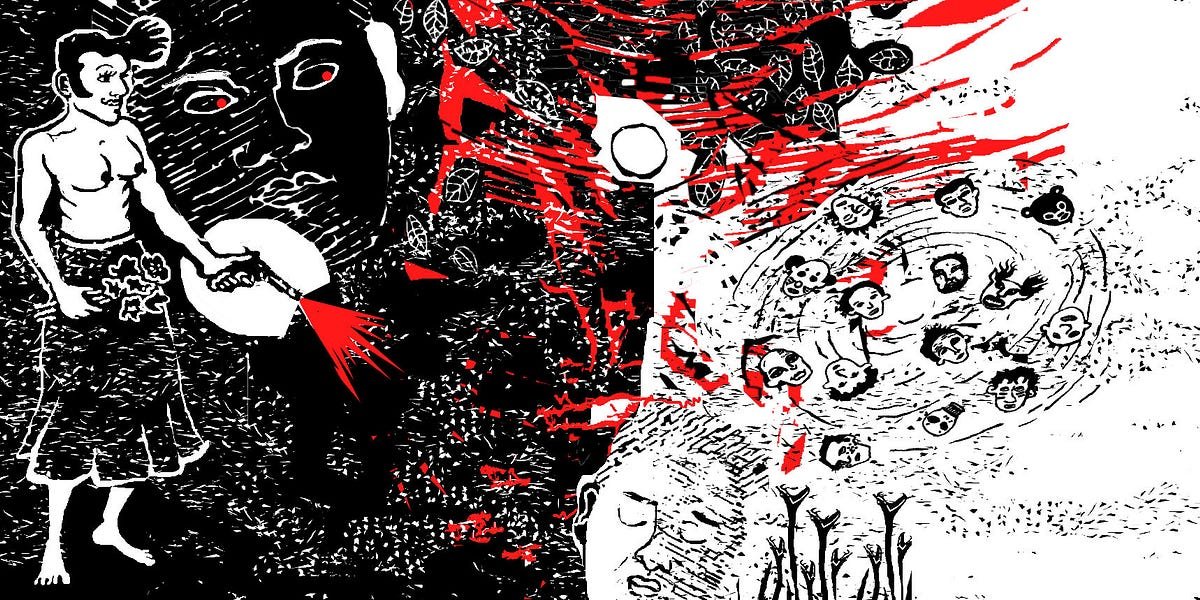
(Art by Michel Horsley))
The Hebrew word for “Knowledge” DatTranslating in Greek GnatThe meaning of internal awareness or insight instead of intellectual knowledge, so that “knowledge of good and evil” can be translated accurately as “moral conscience” (p. 153).
Entertaining enough, this (very simple) thought happened to me a few months ago, although it is an idea consistent with the rhetoric coups of the story, that the snake was relieving Adam and Eve from the occurrence of the tyrant Demiurge; It is very far from a new idea. But then, I recently read Jack Eile SabotageWhich gives a convincing alternative meaning in line with the Christian Jewish view.
Certainly, the goal of the story is that this knowledge came prematurely, before we are ready for such awareness, or the choice between good and evil. If the child’s conscience wakes up very early, they may be ashamed of natural behaviors (imagine a child who realizes a dirty tube).
This is what happened mainly for Adam and Eve, which makes sin and shame inevitable and substitute. Instead of being the other’s cause, it may be almost synonymous.
The ruling has what to do specifically through the wake up prematurely, and in a more general way with early freedom. Children who are granted a lot of freedom will choose unwanted, after which they will suffer. They will even bring terrible things to their lives, such as death! The ethics of the story is that we Need Guidelines from our parents – especially the father – so that we can stand on our feet and make wise choices.
Guyénot Joseph, Ibn Yaqoub, describes as a typical parasite. Joseph begins as a slave in Egypt, closes the ladder to become a pharaoh adviser, gets land holdings in the best parts of Egypt, runs national grain reserves, stores large quantities while the harvest is good in preparing for famine, and gets a good deal, and thus all accumulates on capital. Next, he gets hungry peasants to give up their herds in exchange for grains.
This is a completely different view of the Genesis Book of Gerard, who saw it as a very early text that displays the mechanism of a scapegoat. It will be difficult to reconcile these two perspectives, but it is not impossible, and that doing this would make Guyénot the deeper and more accurate, as well as more persuasive (although it may be difficult to understand).
The difference between, on the one hand, is a “mini” reading of personal dynamics and political social mechanics; On the other hand, between microscopic, symbolic or concentrated reading, and more literal reading, externally directed. Ironically, Guyénot reads Genesis as if it was a reliable history of the Israelis, rather than a symbolic narration aimed at clarifying something else. This is a basic mistake in pathological behaviors that – as Guyénot is constantly argue – was fed through the biblical texts.
Guyénot Henry Ford quotes Jewish international:
Jews gather in their greatest numbers in those places and between these people as they complain that they are the least required. The interpretation often is this; The Jewish genius is to live outside people. Not outside the ground, not outside the production of goods from raw materials, but off people. Leave others until the soil. The Jew, if he can, will live outside Al -Harith. Let others be relieved in trading and manufacturing; The Jew will take advantage of the fruits of their work (p. 51).
Guyénot, after Ford, believes that this intrusion: that Israel, in the literal sense somewhat, lives outside other countries. Quotes from Deuteronomy 6: 10-11:
When the Lord your God has brought you to the earth that he raises to your fathers, to Abraham, to Isaac, and to Jacob, you should give you great and good cities, which you do not build, and are affected by their trees full of trees that are not filled with, and they are dug, and whose no less. When you eat and be beans.
And Isaiah 60:16: “You also absorb the milk of the pagans, and absorb the chest of the kings: I know that I am the Lord I am Your savior and loyalty, one of them is the great of Jacob. “
Guyénot has a number of quotes to support its thesis, and although it is not necessarily removed from the context, it (inevitably) is isolated from other corridors and from the comprehensive image created by the Old Testament. In Nahmiya 6, for example, there is a clip that is clearly an attempt to correct the social social injustice and not to perpetuate:
Moreover, my brothers and my servants lend to money and grains. Let’s stop taking this attention. This day prepared for them the fields of chrome farms, olive orchards, their homes, the benefit of money, grains, wine, and oil that you were raising from them.
https://childrenofjob.substack.com/p/a-subtle-weave